
Discover Birka on Björkö – one of Sweden's most important Viking towns and a UNESCO-listed historical destination in Lake Mälaren. Here, you can experience what life was like during the Viking Age between the 8th and 10th centuries, surrounded by burial grounds, reconstructed houses, and fascinating archaeological discoveries. Birka was likely founded in the late 8th century at the initiative of the Swedish king to control trade in northern Scandinavia. The town quickly became a major trading hub where goods such as Arabic silver, silk, ceramics, and Eastern European beads were exchanged for Scandinavian products like furs, iron, and hides. It is estimated that between 700 and 1,000 people lived here during its peak.
Today, you can explore more than 3,000 visible graves on Björkö, including both cremation graves and inhumation burials, reflecting a society marked by clear social distinctions. Archaeological findings also reveal a strong Viking culture where silver was often melted down and transformed into jewelry and trade goods.
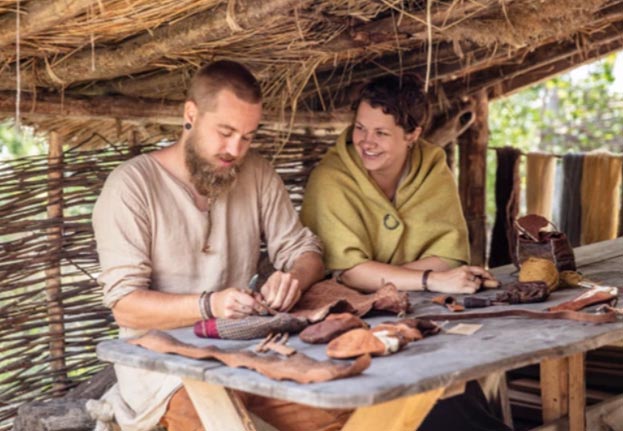
On the island, you can visit a reconstructed Viking quarter with buildings and environments that show how people lived during the Viking Age. This offers a unique opportunity to step directly into history and experience everyday life in a Viking town.
The Christian missionary Ansgar visited Birka several times during the 9th century in an effort to spread Christianity in the region. Today, a memorial known as Ansgar's Cross stands on Björkö, marking a place where history still lives on.
Birka was abandoned in the late 10th century, and the reasons are still debated. Theories suggest political changes or land uplift, which may have made the location less strategically important as a trading center.
The first major archaeological excavations were carried out by Hjalmar Stolpe in the 19th century. Among his discoveries was a large silver hoard containing around 450 Islamic silver coins, as well as several unique pieces of jewelry. Today, many of his findings from Birka are on display at the Swedish History Museum in Stockholm and are considered some of the most important artifacts of Sweden's Viking Age.